Food trucks and street food vendors face a photography challenge that no restaurant, ghost kitchen, or catering company shares: you're shooting in the wild. Your kitchen is a metal box on wheels. Your dining room is a sidewalk. Your lighting is whatever the sky decides to give you. And yet, in an age where customers discover food on Instagram, TikTok, Google Maps, and delivery apps before they ever walk up to a window, the quality of your food photos directly determines how many people show up.
The good news is that street food is inherently photogenic. Bold colors, generous portions, visible textures, and the raw energy of outdoor eating create images that stop people mid-scroll. You just need to know how to capture it. This guide covers everything food truck operators and street food vendors need to know about creating professional-quality images, from essential gear that fits in a cramped truck to styling techniques that make your dishes look irresistible. For foundational photography advice, start with our food photography tips guide.
Why Food Truck Photography Is Different
Photographing food in a traditional restaurant is relatively straightforward. You have a stable surface, controlled lighting, plenty of space to set up, and as much time as you need between services. Food trucks offer none of these luxuries. Understanding what makes food truck photography unique is the first step toward mastering it.
Space Constraints
The average food truck interior is 60-80 square feet of usable workspace. There's no room for a tripod, no counter space that isn't occupied by equipment, and no ability to step back for a wide shot. Every piece of photography gear needs to be compact and stow away in seconds when service gets busy. You're often shooting one-handed while holding a plate with the other, or balancing your phone on a paper towel dispenser because every flat surface is in use.
Outdoor Conditions
Street food vendors don't get to choose their lighting. You might be parked in full sun at a festival, under a highway overpass at a lunch spot, or beneath string lights at a night market. Wind blows napkins into your frame. Rain threatens your equipment. Dust from a gravel lot settles on your carefully plated dish. The environment is constantly working against you, which means your technique needs to be adaptable and fast.
Speed
When you have a line of 30 people waiting, you can't spend 10 minutes styling a single dish. Food truck photography has to happen in the margins: during the brief lull between lunch and dinner, in the minutes before you open the window, or in the 15-second gap between plating and serving. You need a system that lets you capture a usable shot in under 30 seconds.
Brand Identity
Unlike restaurants with carefully designed interiors, a food truck's brand lives in its visual content. Your truck wrap, your social media feed, your menu photos on delivery apps, these are the elements that build recognition. Customers who follow 50 food trucks on Instagram need to recognize your food instantly in their feed. That requires a consistent, distinctive photographic style that becomes synonymous with your brand.
Essential Equipment for Food Truck Shoots
The key principle for food truck photography gear is compact, durable, and quick to deploy. You don't have room for a full studio setup, and you can't afford equipment that takes 10 minutes to assemble. Here's what actually works in a food truck environment:
Phone vs. Camera
For 90% of food truck operators, a smartphone is the right choice. Modern phones (iPhone 14+, Samsung Galaxy S23+, Google Pixel 7+) produce images that rival entry-level DSLRs in good lighting. Phones are always with you, shoot quickly, and transfer directly to social media. A dedicated camera only makes sense if you're doing planned photoshoots outside of service hours or need extremely high resolution for print materials. For a detailed comparison, see our smartphone food photography guide.
Compact Gear That Fits
- Flexible mini tripod ($15-30): A Joby GorillaPod or similar wraps around grab bars, clamps to shelves, and stands on uneven surfaces. Infinitely more useful than a full-size tripod in a truck.
- Clip-on LED light ($20-40): A small, rechargeable LED panel that clips to your phone or mounts on the tripod. Essential for overcast days, shaded spots, and night markets.
- Collapsible reflector ($15-25): A 12-inch reflector bounces natural light onto the shadow side of your dish. Folds flat and stores behind equipment.
- Portable background boards ($20-40): Two or three small surface boards (dark slate, light wood, butcher paper) give you clean background options anywhere. Get them in 12x18 inch size to fit in the truck.
- Phone lens attachment ($15-30): A clip-on macro lens lets you capture extreme close-ups of textures, melting cheese, and sauce details that make social media content pop.
Total investment: under $150. Everything fits in a small pouch that can hang from a hook inside the truck. Compare that to a single professional photoshoot that would cost $1,500-4,000 and can't adapt when you change your menu next week.
Portable Lighting Solutions
When natural light isn't cooperating, you need artificial light that doesn't require a power outlet or take up counter space. Rechargeable LED panels are the best option. Look for lights with adjustable color temperature (3000K-6500K) so you can match the ambient conditions. A warm-toned light at a night market blends naturally, while a cool daylight tone fills in shadows during an overcast afternoon. Battery-powered ring lights that mount on your phone are another solid option for quick, one-handed shooting.
Mastering Outdoor Lighting
Lighting makes or breaks food photography. Indoors, you can control it. Outdoors, you have to work with what you get. The good news is that outdoor light, when handled correctly, produces some of the most beautiful and natural-looking food images possible. For a comprehensive breakdown, see our natural light vs. artificial light guide.
Golden Hour: Your Best Friend
The hour after sunrise and the hour before sunset produce warm, directional light that makes food glow. Sauces look richer. Bread gets a golden sheen. Steam becomes visible and ethereal. If you have the luxury of choosing when to shoot, golden hour is always the answer. For food trucks that operate at lunch markets, this might mean arriving early to shoot before the crowd. For dinner service trucks, the last hour of daylight is prime time.
Midday Sun: Managing Harsh Light
Direct midday sun is the worst light for food photography. It creates harsh, unflattering shadows, washes out colors, and makes everything look flat. If you're shooting at a noon festival, find shade. Park the dish under the awning of your truck. Hold a white t-shirt or napkin between the sun and the food to diffuse the light. Even your own body shadow can improve a shot by blocking the direct sun. The reflector from your kit bounces softer light back onto the shadowed side.
Overcast Days: The Secret Weapon
Experienced food photographers know that a cloudy sky is nature's softbox. Overcast conditions produce even, diffused light with no harsh shadows. Colors look saturated, textures are clearly visible, and you don't need any light modifiers. If you happen to be shooting on a cloudy day, take advantage. Photograph your entire menu. You won't get better natural lighting conditions than this.
Night Markets and After Dark
Night markets and evening events pose the biggest lighting challenge. Overhead string lights cast uneven, yellow light. Your truck's interior fluorescents create unflattering green tones. The solution is to use your portable LED set to daylight temperature (5500K-6000K) and hold it at a 45-degree angle above and to the side of the dish. This mimics natural window light and overpowers the ambient mess. Alternatively, embrace the mood: warm fairy lights and neon signs can become part of a deliberate aesthetic if you lean into it.
Composition in Tight Spaces
Composition is where food truck photography demands creativity. You don't have a spacious table to arrange props and garnishes. You're working with a serving window, a fold-down counter, and whatever surface the parking lot provides. The constraints can actually work in your favor by forcing you into bold, focused compositions. For more composition fundamentals, visit our food photography composition guide.
Overhead from Above the Truck
One advantage food trucks have over restaurants is a natural overhead shooting position. Lean out the serving window and shoot straight down onto the dish resting on the counter below. This flat lay perspective is perfect for tacos, loaded fries, poke bowls, and anything with visible toppings. The truck's counter provides a natural, on-brand background, and the angle is inherently different from what restaurants produce, giving your content a distinctive street food feel.
45-Degree Through the Window
Shooting from outside the truck at a 45-degree angle through the serving window creates depth and context. You capture the dish in the foreground with the truck's interior blurred behind it. This angle tells a story: it puts the viewer in the customer's shoes, looking at their food as it's handed to them. It works particularly well for stacked items like burgers, burritos, and sandwiches where you want to show layers and height.
Customer POV
The customer point-of-view shot is simple and effective: hold the food at arm's length with the truck or street scene blurred behind it. This "hero shot" perspective is one of the most shared formats on social media because it's relatable. Everyone knows the feeling of holding a freshly handed dish and looking at it with anticipation. Shoot with portrait mode to blur the background and keep focus tight on the food. Include a hand or branded wrapper to add a human element.
The Line and the Scene
Don't forget to capture the wider scene. A long line of customers waiting at your truck, steam rising from the grill, the truck itself lit up at a night market. These contextual shots build brand atmosphere and work as cover images for social profiles, website headers, and Google Business listings. They show social proof and create FOMO in a way that close-up food shots alone cannot.
Styling Street Food for Maximum Impact
Street food styling follows different rules than fine dining photography. Nobody expects a perfectly plated micro-herb garnish from a taco truck. In fact, overly polished images can backfire by looking inauthentic. The best street food photography embraces the beautiful mess.
Embrace the Messy
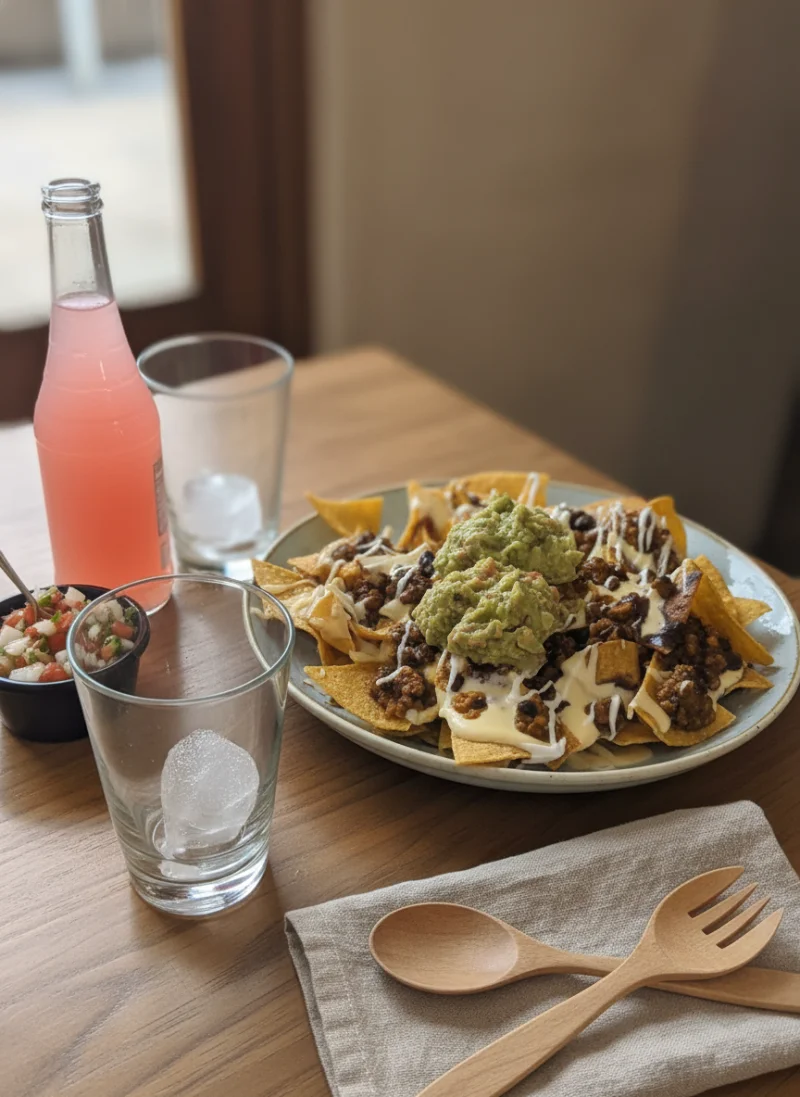
Street food should look like street food. A perfectly clean plate with mathematically placed toppings feels wrong for a loaded burrito or a pile of BBQ nachos. Let the sauce drip. Let the cheese ooze over the edge. Let the toppings overlap and pile up. Controlled chaos is the aesthetic. The key word is "controlled" — you want it to look indulgent and generous, not sloppy. Think of it as the difference between a bed that looks casually unmade and one that looks like a tornado hit it.
Sauce Drizzles and Finishing Touches
The moment you drizzle sauce across a finished dish is one of the most powerful shots in food photography. Shoot a quick video of the drizzle and pull the best frame, or take a burst of photos while the sauce is mid-air. Hot sauce on tacos, aioli on a burger, melted cheese being pulled apart — these action moments create dynamic images that outperform static shots every time. Keep a squeeze bottle handy specifically for these photo-finishing moments.
Steam and Action Shots
Hot food should look hot. Steam rising from a fresh bowl of ramen, smoke curling off a grilled steak, the sizzle of onions on a flat top. These sensory cues trigger cravings in a way that a cold, static image simply cannot. To capture steam, shoot against a dark background with side lighting. The steam becomes visible as it catches the light. Shoot quickly, because steam dissipates in seconds. If the dish has cooled, hold it near the grill exhaust briefly to generate visible vapor.
Paper, Foil, and Wrappings
Street food is served in paper boats, foil wraps, wax paper, and cardboard trays. Use this to your advantage. The packaging is part of the story. A gyro wrapped in branded paper, a corn dog in a printed sleeve, fries overflowing from a red-checked paper basket — these elements scream "street food" and add authenticity that a white plate never could. If your truck uses custom-printed wrappers or branded containers, always include them in your photos. It's free brand exposure in every image.
Creating a Cohesive Brand Look
Consistency is what separates a food truck with 500 Instagram followers from one with 50,000. When someone scrolls your feed, every image should feel like it belongs to the same brand. This doesn't mean every photo looks identical — it means they share a visual DNA. For a deeper dive into photography and brand building, read our restaurant branding through food photography guide.
Consistent Backgrounds
Pick two or three surfaces that become your signature. Maybe it's the stainless steel counter of your truck, a dark slate board, and the sidewalk outside your regular spot. Use these same surfaces for every photo. Your audience starts associating that look with your food, building subconscious brand recognition. Avoid switching backgrounds randomly — a marble surface one day, a picnic table the next, and a car hood the day after that looks chaotic, not creative.
Signature Editing Style
Apply the same editing treatment to every photo. Whether it's warm and saturated, cool and moody, or bright and punchy, consistency is what matters most. AI enhancement tools like Platora let you save custom themes that apply your brand's specific look to every image automatically. Shoot a taco on Monday and a quesadilla on Friday, apply the same theme, and both images feel like they came from the same brand universe.
Include the Truck
Your truck is your most recognizable brand asset. Include it in some of your photos — not every one, but regularly. A shot of your signature dish held up in front of the truck's window, a photo of the menu board with food in the foreground, or a wide shot of the truck at a popular location all reinforce brand identity. These "hero + truck" images work especially well for Google Business profiles, Yelp listings, and featured social posts.
Shooting for Social Media & Delivery Apps
Food trucks typically need images for two very different contexts: social media (Instagram, TikTok, Facebook) and delivery app listings (Uber Eats, DoorDash, Grubhub). Each has different requirements and best practices. For a thorough breakdown of both, see our guide to food photography for social media.
Social Media: Tell a Story
Social media content thrives on personality, movement, and behind-the-scenes energy. For Instagram and TikTok, focus on:
- Vertical video (9:16): Reels and TikToks of food being assembled, sauces being drizzled, and orders being handed out the window consistently outperform static images.
- Square crops (1:1): For Instagram grid posts, square images display largest and allow tight framing on the dish.
- Behind-the-scenes content: Show the grill at work, the prep process, the team high-fiving after a rush. Authenticity drives engagement for food truck brands.
- Customer interactions: With permission, capture the moment a customer takes their first bite or their reaction when they see the food. User-generated content builds community.
Delivery Apps: Clean and Clear
Delivery app listings require a completely different approach. These images appear as small thumbnails and need to communicate the dish instantly:
- Fill the frame: The dish should occupy at least 70% of the image. No wide shots, no excessive negative space.
- Clean, simple backgrounds: Neutral surfaces with no distracting elements. The food must be the sole focus.
- High contrast and saturation: Thumbnails need bold colors to stand out against competing listings.
- Platform-specific sizes: Uber Eats prefers landscape (1200x800px), DoorDash and Deliveroo prefer square (1200x1200px). AI tools let you export multiple sizes from one shot.
- Accurate representation: Show what the customer will actually receive. Over-styling leads to complaints and bad reviews.
Common Mistakes to Avoid
Even experienced food truck operators fall into these photography traps. Recognizing them is half the battle:
Cluttered Backgrounds
The biggest mistake in food truck photography is ignoring what's behind and around the food. A beautiful burger loses its impact when there's a trash can, a ketchup-stained napkin dispenser, and a stack of plastic cups in the background. Before every shot, scan the entire frame. Remove anything that doesn't contribute to the image. Move the dish if needed. A clean background takes two seconds of effort and makes a dramatic difference in the final photo.
Harsh Shadows
Shooting in direct midday sun without any diffusion creates dark, sharp shadows that cut across the food and make it look unappetizing. The shadow from the truck's awning, the edge of the serving window, or your own hand can bisect the dish. Always check for shadow lines before shooting. Move to open shade, use a diffuser, or wait for a cloud to pass. If you're stuck in harsh light, use your reflector to fill the shadows from the opposite side.
Ignoring the Truck Itself
Your truck is your storefront, your billboard, and your brand identity all in one. Too many food truck operators focus exclusively on close-up food shots and never photograph the truck itself. You need a mix of both. Close-ups sell individual menu items, but wide shots of the truck sell the experience. A photo of your brightly lit truck at a night market, with a line of eager customers, is marketing gold. Include the truck in your content rotation, especially for Google Business, website headers, and social media highlights.
Inconsistent Quality
Posting a stunning, professionally-enhanced photo one day and a blurry, dark phone snap the next damages your brand more than posting nothing at all. It tells your audience you don't care enough to maintain a standard. If you can't achieve consistent quality manually, use AI tools to normalize your images. Upload every photo through the same enhancement process, and your feed maintains a professional, cohesive look regardless of when or where you shot the original.
Putting It All Together
Food truck photography is demanding because the conditions are never ideal. But that's also what makes it rewarding. The energy of a street food scene, the vibrant colors of fresh-made dishes, the raw authenticity of food handed through a window — these elements create images with a magnetism that studio shots can never replicate.
Here's a practical workflow for food truck operators:
- Before service: Set up your mini photo station. Clean a surface, position your background board, check the light. Shoot any new menu items while you have time and space.
- During service: Capture 2-3 quick action shots — a sauce drizzle, food being handed out, the grill in action. These take seconds and fuel your social content.
- After service: Upload your best shots to an AI tool like Platora. Apply your brand's saved theme. Export for social media and delivery platforms.
- Weekly: Post 3-5 times to social media. Update delivery app listings with any new or improved images.
The food truck operators who commit to this rhythm build the kind of visual brand that turns casual followers into regular customers. Your food already tastes incredible. Now make sure it looks the part. For more on styling and post-processing, explore our guides on props and backgrounds and food photography editing.